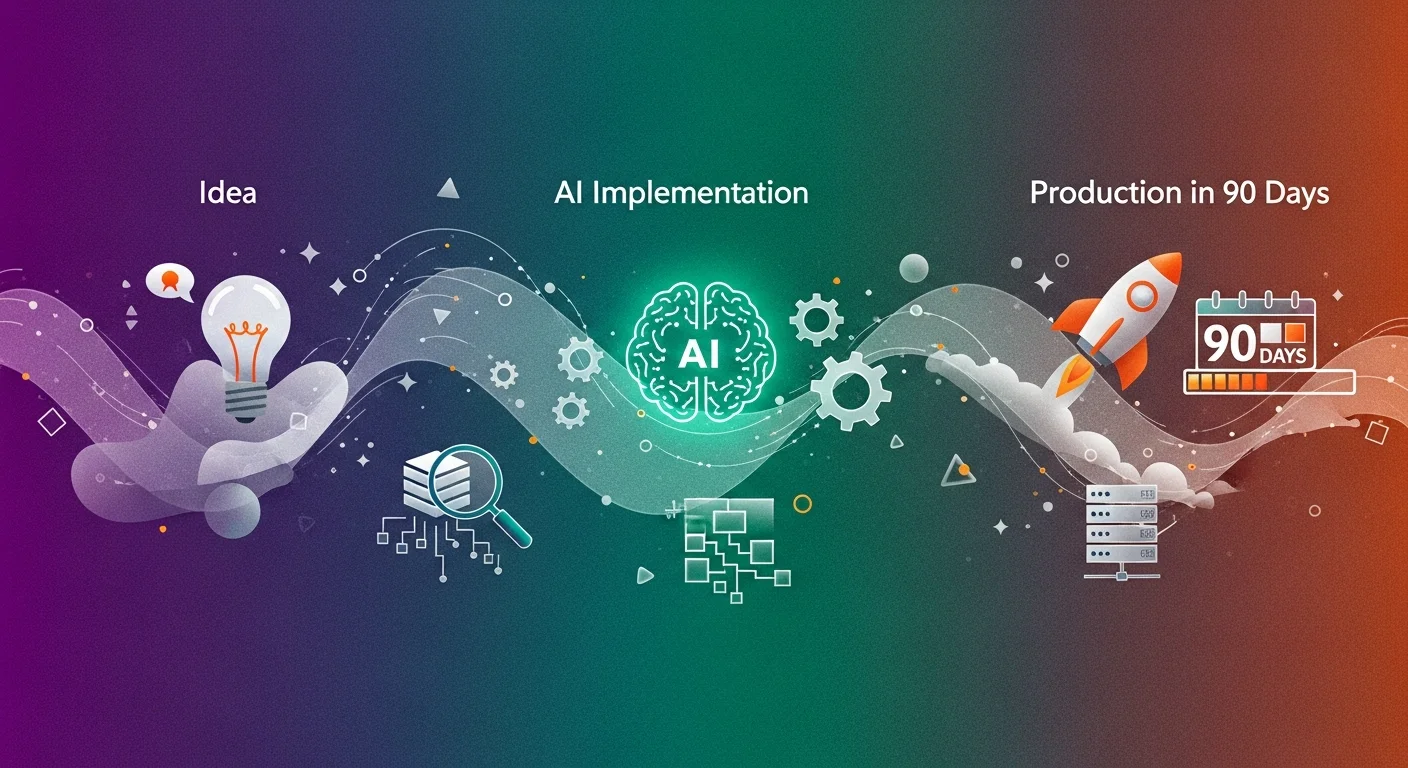
90 days. That is all you need to go from "we should do something with AI" to a working AI solution that delivers real results.
In this article we share our proven roadmap, including week-by-week planning and practical checklists.
The 90-day AI implementation framework
Week 1-2: discovery and alignment
Goal: get everyone on the same page and pick the right use case
Week 1: stakeholder alignment
- Kick-off meeting with key stakeholders
- Document the current processes
- Map the pain points and the wishes
- Identify quick wins
Week 2: use case selection
- Score potential AI use cases (impact versus feasibility)
- Work out the top 3 use cases
- Calculate the business case
- Take a go/no-go decision
Deliverables:
- AI opportunity assessment
- Chosen use case with business case
- Project charter with scope and KPIs
Week 3-4: design and planning
Goal: technical design and detailed planning
Week 3: solution design
- Draw up the functional requirements
- Design the technical architecture
- Identify the integration points
- Define the data requirements
Week 4: project planning
- Build the detailed plan
- Allocate resources
- Run a risk assessment
- Draw up the communication plan
Deliverables:
- Technical design document
- Project plan with milestones
- Resource planning
- Risk register
Week 5-8: build and test
Goal: build the AI solution
Week 5-6: core development
- Configure or train the AI model
- Backend development
- Build the APIs
- Put the first integrations in place
Week 7-8: testing and refinement
- Unit testing
- Integration testing
- User acceptance testing
- Bug fixing and optimisation
Deliverables:
- Working AI solution in a test environment
- Test report
- Documentation for users
Week 9-10: pilot and feedback
Goal: go live with a limited group
Week 9: pilot launch
- Select the pilot group (5 to 10 users)
- Deliver the training
- Pilot go-live
- Set up the support structure
Week 10: feedback and iteration
- Daily check-ins with pilot users
- Collect and analyse feedback
- Implement quick fixes
- Measure performance against the KPIs
Deliverables:
- Pilot feedback report
- Improved version of the AI solution
- Go/no-go for the full rollout
Week 11-12: rollout and optimisation
Goal: organisation-wide rollout
Week 11: full rollout
- Communication to the whole organisation
- Training for all users
- Step-by-step rollout per department
- Set up the support desk
Week 12: optimisation and handover
- Performance optimisation
- Finalise the documentation
- Handover to operations
- Retrospective and recorded learnings
Deliverables:
- Production-ready AI solution
- User documentation
- Operations handover
- Retrospective report
Success metrics template
Track these KPIs throughout your implementation:
| Metric | Baseline | Target | Week 4 | Week 8 | Week 12 |
|---|---|---|---|---|---|
| Time per task | X hours | -50% | |||
| Error rate | X% | -80% | |||
| Customer satisfaction | X | +20% | |||
| Cost per transaction | €X | -30% | |||
| Employee adoption | 0% | 80% |
Common delays (and how to prevent them)
1. Scope creep
Risk: "Could we add X as well?" Prevention: strict scope governance. New features come after the MVP.
2. Data problems
Risk: data is not clean, incomplete, or out of reach Prevention: a data assessment in week 1 and 2. Reserve buffer time for data cleaning.
3. Stakeholder availability
Risk: key stakeholders are not available to take decisions Prevention: commitment up front. Block the calendars. Clear escalation paths.
4. Integration complexity
Risk: legacy systems turn out to be harder to connect than expected Prevention: an early integration assessment. A technical spike in week 3.
Next steps
Ready to start?
- Download our AI implementation checklist: every checklist in one document
- Book a discovery call: talk through your situation with a specialist
- Read as well: AI Implementation in the Netherlands: the complete guide
Related articles: