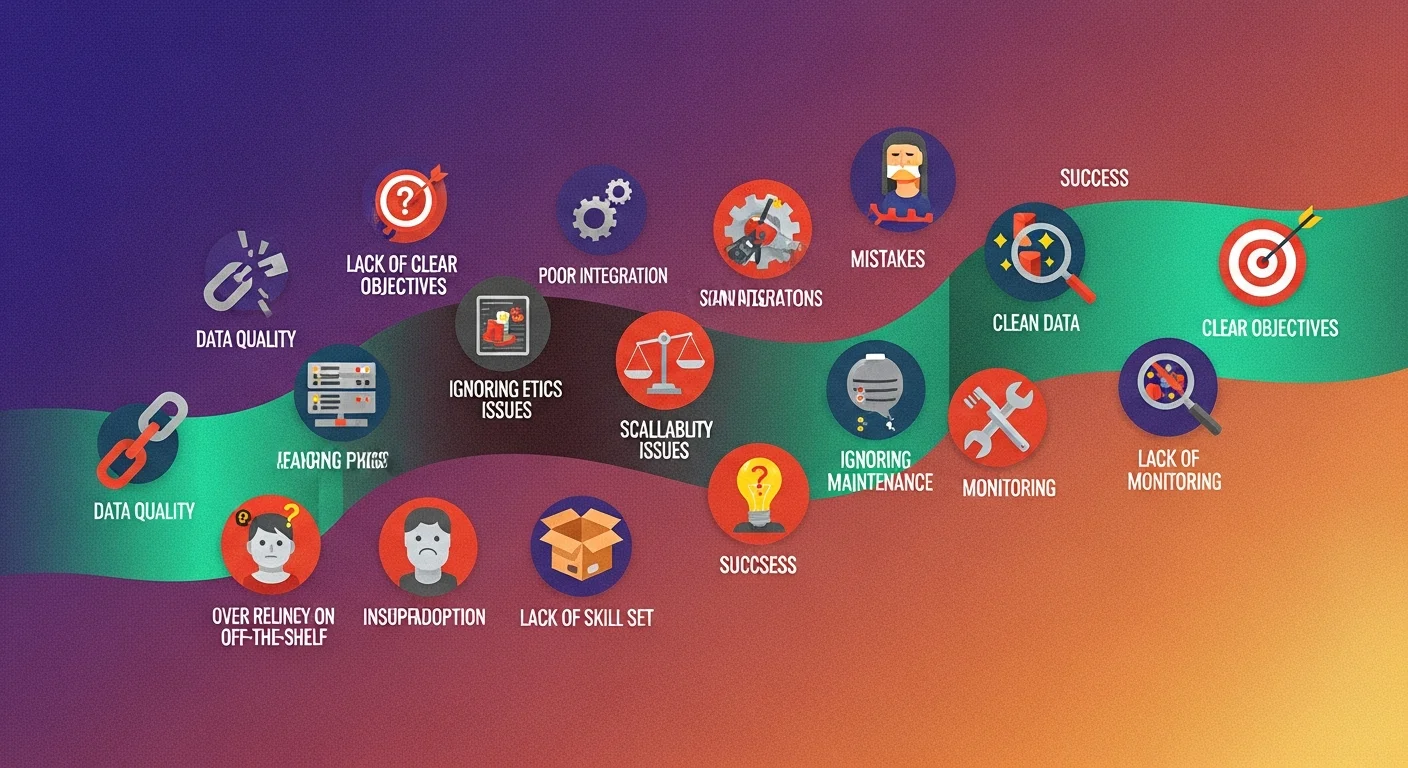
After 50+ AI implementations we have seen them all: the successes and the failures. The difference? Usually not the technology, but the approach.
In this article we share the 10 most common mistakes, and more importantly, how you avoid them.
Mistake 1: starting too big
The problem: "We are going to digitise the whole organisation with AI!"
Why it goes wrong:
- Overwhelming scope
- Unclear priorities
- No quick wins to build momentum
- Stakeholders lose interest
The solution: Start with one concrete use case with high impact and low complexity. Prove the value in 90 days. Use that success to win budget and buy-in for the next phase.
Example: an insurer wanted to "automate all claims". We started with fraud detection alone. Success there opened doors for the rest.
Mistake 2: no clear KPIs
The problem: "AI has to make us more efficient" (but how do you measure that?)
Why it goes wrong:
- No baseline to measure improvement against
- A subjective judgement of success
- No data for the business case for the next phase
The solution: Define up front:
- Which metrics improve?
- By what percentage?
- Within what timeframe?
- How do we measure it?
Template:
| KPI | Baseline | Target | Measurement |
|---|---|---|---|
| Time per task | 4 hours | 1 hour | Time tracking |
| Error rate | 15% | 3% | QA sample |
| Customer satisfaction | 7.2 | 8.5 | NPS survey |
Mistake 3: poor data quality
The problem: garbage in, garbage out
Why it goes wrong:
- AI learns from your data
- Bad data means bad results
- Data cleaning gets underestimated
The solution:
- A data assessment up front
- Invest in data cleaning
- Start with a subset of good quality data
- Build data governance in parallel
Mistake 4: no executive sponsorship
The problem: the AI project is carried by one enthusiastic employee
Why it goes wrong:
- No budget when the wind turns
- No authority to push decisions through
- Other priorities always win
The solution:
- A C-level sponsor from day 1
- A regular steering committee
- AI on the board agenda
Mistake 5: technology first, people later
The problem: all the focus on the AI, forgetting that people have to work with it
Why it goes wrong:
- Resistance from your team
- Low adoption
- The AI gets worked around
The solution:
- Change management alongside development
- Involve your people in the design
- Training well before go-live
- Build a network of champions
Mistake 6: choosing the wrong partner
The problem: a consultant with no hands-on experience, or a tech company with no business knowledge
Why it goes wrong:
- Solutions that work technically but miss the business value
- Or: beautiful slide decks but no working code
The solution: Check with your partner:
- References in your sector
- Working demos (not only slides)
- Both tech and business expertise
- Transparent pricing
- Post-launch support
Mistake 7: ignoring security and compliance
The problem: "We will sort that out later"
Why it goes wrong:
- GDPR breaches
- Data leaks
- Reputational damage
- Fines
The solution:
- Privacy by design
- A security assessment in week 1
- A compliance check for every phase
- Bring in your DPO
Mistake 8: no plan for after go-live
The problem: all the budget goes to development, nothing to operations
Why it goes wrong:
- Nobody maintains the AI
- Performance degrades
- Bugs pile up
- Users drop off
The solution:
- Reserve an operations budget (15 to 20% of development)
- Define the support structure up front
- Monitoring from day 1
- Plan an iteration roadmap
Mistake 9: underestimating integration complexity
The problem: "We will just hook it up to our CRM"
Why it goes wrong:
- Legacy systems
- Missing APIs
- Data format mismatches
- Rate limiting
The solution:
- A technical assessment up front
- Bring in an integration expert
- Plan in buffer time (30 to 50% extra)
- Think through fallback scenarios
Mistake 10: expecting AI to do everything
The problem: "The AI will solve it"
Why it goes wrong:
- AI is a tool, not magic
- Some tasks are not suited to AI yet
- Disappointment leads to the project being cancelled
The solution:
- Manage expectations realistically
- Select use cases on feasibility
- Keep a human in the loop where it is needed
- Celebrate success at an 80% solution instead of demanding 100%
Checklist: avoid these mistakes
Use this checklist for your AI project:
- One concrete, bounded use case
- Clear, measurable KPIs
- Data assessment done
- Executive sponsor committed
- Change management planned
- Partner checked on references
- Security and compliance reviewed
- Operations budget reserved
- Integration complexity assessed
- Expectations aligned
Next steps
Take the free AI readiness scan to check whether you are ready for AI implementation.
Or read on: