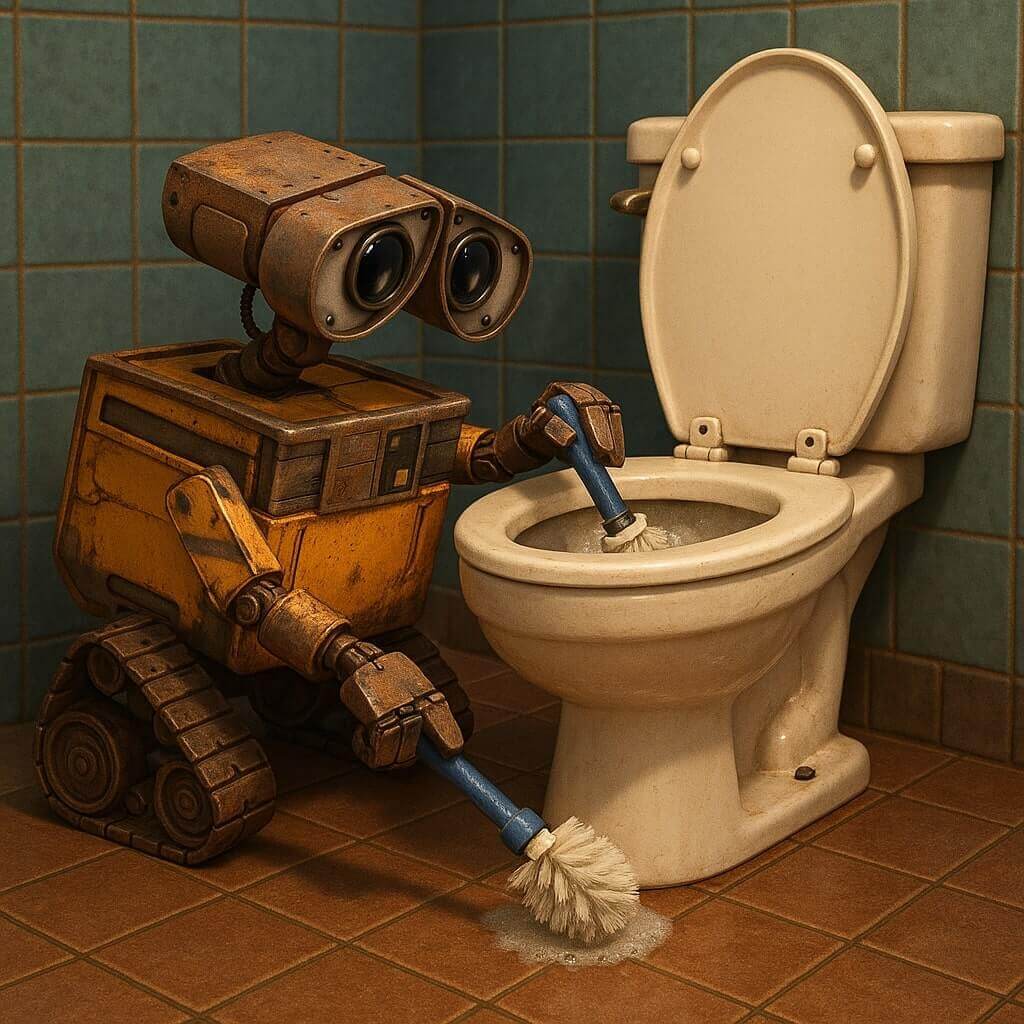
Do you need to look for a new job because of AI?
Is AI going to take my job? That is probably the question that has been on your mind for months. And honestly? I completely understand the uncertainty. Lately it feels as if a new AI story comes past every single day. Google's CEO Sundar Pichai says they now process 480 billion tokens per second. Goldman Sachs predicts that 300 million jobs will disappear because of AI. And meanwhile you are sitting there wondering whether your job will still exist tomorrow. But here is the thing: this revolution is not about robots replacing you. It is about people who understand AI and use it replacing people who do not. And after digging through conversations with the biggest tech leaders and AI experts, I am going to tell you exactly how to make sure you end up on the winning side.
What is AI, really?
Let's get clear first on what we are talking about. AI is not one thing. It is a collection of technologies that can imitate human brain functions. Think of recognising images, understanding language, predicting patterns and making decisions.
But here is what nobody tells you: AI does not understand human emotions and cannot act of its own accord. It is a tool. A powerful tool, but still a tool that has to be steered by people who know how to work with it.
Today's AI systems can process enormous amounts of data in a fraction of the time a person would need. They can solve complex problems, but they lack creativity, empathy and the ability to make ethical decisions. And those are exactly the qualities you can score with as a human being.
Which jobs and sectors get hit hardest?
Okay, let's be honest. Some jobs really are at risk. And I am not going to pretend otherwise.
Research from the University of Oxford shows that administrative and analytical professions are the ones set to disappear. We are talking about accountants (94% chance of automation), transport planners (99%) and legal assistants (94%). But professions that create content are under threat too: programmers, SEO specialists, copywriters and editors.
Why these jobs in particular? Because they are repetitive, rule based and need little human interaction. AI is brilliant at following patterns and carrying out predictable tasks.
But here comes the plot twist: for every job that disappears, new ones are created. The World Economic Forum predicts that 85 million jobs will be lost worldwide, but that 97 million new ones will appear. So the question is not whether there is work, but whether you have the right skills for that new work.
Sectors like SEO and online marketing are changing radically. Where we used to spend months on content strategies, we can now set up complete campaigns within a day using AI tools. The question is: are you the one steering those tools, or are you letting them replace you?
The public sector stays safe (for now)
Good news if you work in healthcare, education or government. These sectors stay relatively safe because they depend on human contact, empathy and complex decision making. Patients need understanding and support, students need inspiring teachers, and citizens need to trust that real people are making the decisions.
Robots can automate tasks, but showing real empathy or making ethical judgements? That is still a bridge too far for AI.
How do you arm yourself against the AI revolution?
Here is where it gets interesting. Because instead of fighting the change, you are going to work with it.
The key is not specialisation, but adaptation. The marketers, designers and business owners performing best right now? They have one thing in common: they embrace AI as their secret weapon.
Take the story of a sales team that uses AI for RFPs (requests for proposal). Where four people used to need days to write a single proposal, one person now does the same work in 15 minutes. That one person was not replaced, they became superpowered.
Three ways to prepare yourself:
-
Become an AI coordinator: learn how to put AI tools to work so you do your job better and faster
-
Develop your human superpowers: focus on creativity, empathy, strategic thinking and problem solving
-
Keep learning: the tools change constantly, so curiosity is your best asset
Which AI tools should you learn now?
Right, time to get practical. Which tools are you installing this week?
The basic toolkit everyone should know
ChatGPT is your starting point. Not only because it is good, but because it teaches you how to "talk" to AI. Writing good prompts is a skill in itself.
Claude is my personal favourite for more complex tasks. It reasons better and handles longer texts than most other tools.
Perplexity is what you use when you need recent information. It searches the internet in real time and gives you the sources with it.
For the more technical among us
If you want to dive into the AI world, you should also look at code generation tools such as Cursor, Windsurf and Loveable. These tools let you go from idea to working software without being a programming expert.
Canva AI for visual content. HubSpot's AI tools for marketing automation. Notion AI for productivity.
The point is not to become an expert in every tool, but to understand how AI can improve your specific work.
Learn to live on the internet
This might sound vague, but it is crucial. The best AI users are people who are constantly online, see trends coming and pick up new tools fast.
Follow the right sources: X (Twitter), LinkedIn, YouTube channels of AI experts. Do not just read about AI, use it every day.
Experiment every day: try one new AI tool a week. Not to become an expert, but to see what is possible.
Specialisation vs generalism: which strategy wins?
And here comes the most important insight in this whole article.
"A generalist is going to crush it over the next few years."
Alex Lieberman, founder of Morning Brew, puts it like this: "If I hire a marketer next year, how much marketing experience someone has matters less than ever before. I do not care how much social media experience you have. I want to know: how creative are you and how much do you live on the internet?"
The old rules are broken. You used to be rewarded for specialisation. Ten years of email marketing experience? Perfect, you are hired. But that expertise is worth less now because the fundamentals of marketing are changing completely.
In the new world you almost get punished for being too specialised. Everything is changing so fast that generalists perform far better. You need to be able to think broadly, learn fast and put AI tools to work to improve what you do.
The barbell strategy
But there is one exception. If you want to survive in the AI world, you need to sit at one of the two extremes:
Extremely creative: coming up with ideas AI cannot produce yet. Telling stories that move people. Solving problems in ways nobody else thought of.
Extremely technical: building AI systems, automating processes, analysing data at the highest level. Thinking like an engineer, basically.
Everything in between, the average marketer, the standard accountant, the regular customer service rep, that gets difficult.
Why generalists win
In marketing, for example, you no longer need to manage a whole team. You only need to manage AI and agents, and they are far more independent than traditional software.
The question is no longer: "Can you do ten years of email marketing?"
The question now is: "Can you coordinate several AI agents as a generalist and get a portfolio of work done?"
And that is where people with broad skills, curiosity and the will to learn win.
Your future in the AI world
Let's be honest: the world is changing faster than most people realise. It is like that old metaphor of the frog in boiling water: if the water heats up gradually, you do not jump out. But if you jumped in right now, you would leap straight back out.
Is AI going to take your job? Maybe. But it is more likely that someone who handles AI better than you will take your job.
The good news? You still have time to learn. Start with ChatGPT today. Experiment with other tools. Follow the developments. And above all: stay curious.
Because in a world where everything changes, curiosity is your best asset. The people who want to learn, who are open to change, and who see AI as an opportunity rather than a threat, those are the people who are going to win.
Is AI going to take your job? Only if you let it happen.
The choice is yours. You can sit still and hope it all blows over. Or you can start today: learning, experimenting and preparing yourself for the future. What are you going to choose?