You have probably heard of SaaS, PaaS and IaaS. But there is a new service model gaining ground: Intelligence as a Service. The concept is simple. Instead of training AI models yourself, hiring data scientists and buying GPU clusters, you tap into ready-made AI capacity through the cloud or through a specialised partner. You pay for what you use, without the overhead of your own AI department.
For many Dutch business owners that sounds appealing, and rightly so. But there are important nuances that make the difference between a smart investment and an expensive disappointment. As an AI implementation partner we see every day where companies get stuck when they want to use AI without reinventing the wheel.
What exactly is Intelligence as a Service?
Intelligence as a Service, often shortened to AIaaS (Artificial Intelligence as a Service), is a cloud based business model that lets organisations use artificial intelligence and machine learning capabilities without building expensive infrastructure themselves. Compare it with how you already use software through SaaS models such as Exact Online or HubSpot: you pay a subscription or per use, and the provider takes care of the technical layer underneath.
The difference from traditional IT outsourcing is that with Intelligence as a Service you are not only renting computing power, but the intelligence itself. Think of pre-trained language models that answer your customer questions, algorithms that recognise patterns in your financial data, or AI agents that handle complete workflows. You do not have to hire your own data scientists or spend months training models.
Why do Dutch companies choose Intelligence as a Service?
In practice, most smaller businesses simply do not have the resources to build a full AI team. A good machine learning engineer quickly costs more than a hundred thousand euros a year, and that is before you have arranged any infrastructure, data pipeline or maintenance. Intelligence as a Service lowers that barrier considerably.
But cost is not the only reason. A law firm we worked with wanted to speed up contract analysis but had no AI expertise in house. By using Intelligence as a Service they had a working system analysing contracts for risk clauses within a few weeks. The firm did not have to train any models of its own. Instead, we configured a solution based on European language models, hosted on dedicated servers inside the EU, fully GDPR compliant.
That last point is crucial for Dutch companies, and something plenty of generic AIaaS providers overlook.
The GDPR problem nobody talks about
Most of the big AIaaS platforms run on American servers. OpenAI, Google Cloud AI, AWS, all of them companies under US jurisdiction. For a webshop generating product descriptions that is rarely a problem. But as soon as you push customer data, financial records or medical information through an AI model, it becomes a different story.
The GDPR sets strict requirements for where personal data is processed and stored. And since the Schrems II ruling, the legal basis for transferring data to the US has remained shaky, despite the EU-US Data Privacy Framework. Accountancy firms, law firms, wealth managers and healthcare providers simply cannot afford to send client data to an American platform.
The solution? Self-hosting with European language models. Models such as Mistral, developed by a French team of former Google DeepMind and Meta researchers, deliver performance comparable to GPT-4 for many business applications, but running on your own servers inside the EU. Your data never leaves the European continent, and you keep full control over who has access.
How does Intelligence as a Service differ from a one-off AI implementation?
With a one-off implementation you build an AI solution, hand it over and you are done. Intelligence as a Service is an ongoing model. The AI keeps getting adjusted, new models get integrated as they become available, and performance is monitored and optimised.
In practice that is the difference between having an AI agent built once and an ongoing service where that agent grows along with your business. New customer questions get picked up, workflows get sharpened, and when a better language model arrives it gets integrated seamlessly.
For companies that are serious about AI, that ongoing character is a real advantage. AI is not a static technology. What is the best model today may be outdated in six months. With Intelligence as a Service you do not have to track those developments yourself.
Which forms of Intelligence as a Service exist?
The market has roughly three categories. First there are the big cloud platforms such as AWS, Azure and Google Cloud that offer ready-made AI services through APIs. You send data to their servers, get a result back and pay per call. Easy to start with, but limited in how far you can adapt it, and with the privacy questions mentioned earlier.
Second there are specialised AIaaS providers focused on specific domains. Think of companies offering AI for document analysis, fraud detection or customer service as an off-the-shelf service. Often effective, but you are tied to their platform and their way of working.
And third there is the model we use at Green Creatives: an implementation partner delivering Intelligence as a Service with full control over your data. We work with European language models, run on dedicated servers with dedicated databases, and build solutions tailored specifically to your business processes. Not a generic platform where you have to work out how it functions, but bespoke work that delivers value straight away.
Concrete applications per sector
Intelligence as a Service is broadly applicable, but the value differs per sector. For accountancy firms we see the biggest gains in automating document processing and anomaly detection in financial data. The AI model analyses source documents, extracts the relevant details and flags deviations, so the accountant can focus on the advisory conversation.
At law firms the strength lies in contract analysis and legal research. An AI system that searches thousands of pages of case law in the time a junior needs for a single case. The lawyer makes the strategic judgement, the AI model does the groundwork.
In healthcare it is mostly about easing the administrative load. An AI phone assistant that triages, books appointments and answers standard questions, so the practice has more time for patient care. And among smaller businesses we increasingly see Intelligence as a Service used for lead generation, quote follow-up and customer communication.
What should you look for when choosing a provider?
Not every AIaaS provider is the same, and the choice has far-reaching consequences for your business. The first thing to look at is data sovereignty: where is your data processed and stored? If the answer is "in the US", ask explicitly about the legal basis and whether that fits your compliance obligations.
The second point is vendor lock-in. Many platforms make it easy to start and hard to leave. Your data is stuck in their ecosystem, your prompts and configurations are not transferable, and the moment you want to switch you are back at square one. So choose solutions that run on open standards and where you remain the owner of your configuration and your data.
The third criterion is the degree of customisation. A generic platform delivers generic results. For most business applications you need a solution tuned to your sector, your terminology and your processes. That is the difference between a chatbot giving vague answers and an AI assistant that knows exactly how your company works.
The cost of Intelligence as a Service
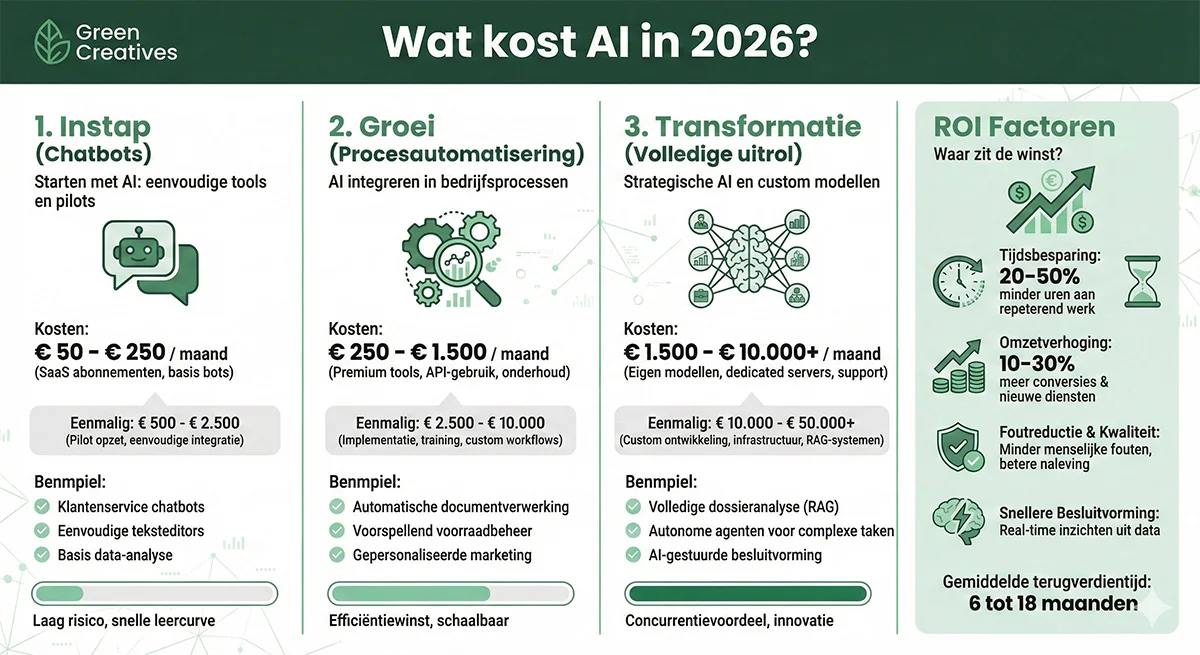
The investment varies a lot, depending on the complexity and the model you choose. With the big cloud platforms you pay per API call. That can start at a few cents per request and climb to tens of euros with intensive use of advanced models. The advantage is that you only pay for what you use. The drawback is that costs can mount quickly at high volume.
With an implementation partner such as Green Creatives we usually work with a combination of a one-off setup investment and a monthly management fee. The setup investment covers the design, the configuration and the integration with your existing systems. The monthly fee covers hosting, monitoring, updates and ongoing optimisation.
Common misconceptions about Intelligence as a Service
The biggest misconception is that AIaaS is a magic solution you can flip on like a light switch. The reality is that every AI system has to be trained on your data, tuned to your processes and tested in your context. Intelligence as a Service lowers the barrier considerably, but it does not remove the need for a solid implementation.
A second misconception is that AI makes your team redundant. That is not the case. Right now AI is strongest as a way to amplify human capacity, not to replace it. The accountant using AI for data extraction can serve more clients and give better advice. The lawyer using AI for contract analysis finds the risk clauses faster. But the strategic judgement, the client conversation and the final responsibility remain human work.
And the third misconception: that you can solve everything with ChatGPT and a good prompt. For simple tasks that works fine. But as soon as you need reliability, privacy and scalability, you quickly end up needing a professional Intelligence as a Service solution set up specifically for your business.
The future of Intelligence as a Service
The AIaaS market is growing explosively. Analysts put the global market value at more than 17 billion dollars in 2026, with expected growth to more than 130 billion by 2033. That growth is driven by the increasing availability of powerful open source models, falling compute costs and rising demand from smaller businesses.
For Dutch companies, the combination of European AI models and local hosting is what becomes interesting over the coming years. The European AI Act, which came into force in stages during 2025, sets additional requirements for the transparency and accountability of AI systems. Companies already working with compliant solutions on their own infrastructure have a head start.
We expect Intelligence as a Service to become the standard for smaller businesses using AI within two to three years. Just as SaaS changed the way companies use software twenty years ago, AIaaS is now changing the way companies use intelligence. The difference is that the companies adopting it early build a structural competitive advantage that is hard to close.
Curious what Intelligence as a Service could concretely mean for your business? Book a no-obligation call and we will show you where the opportunities are for your sector and your compliance requirements.