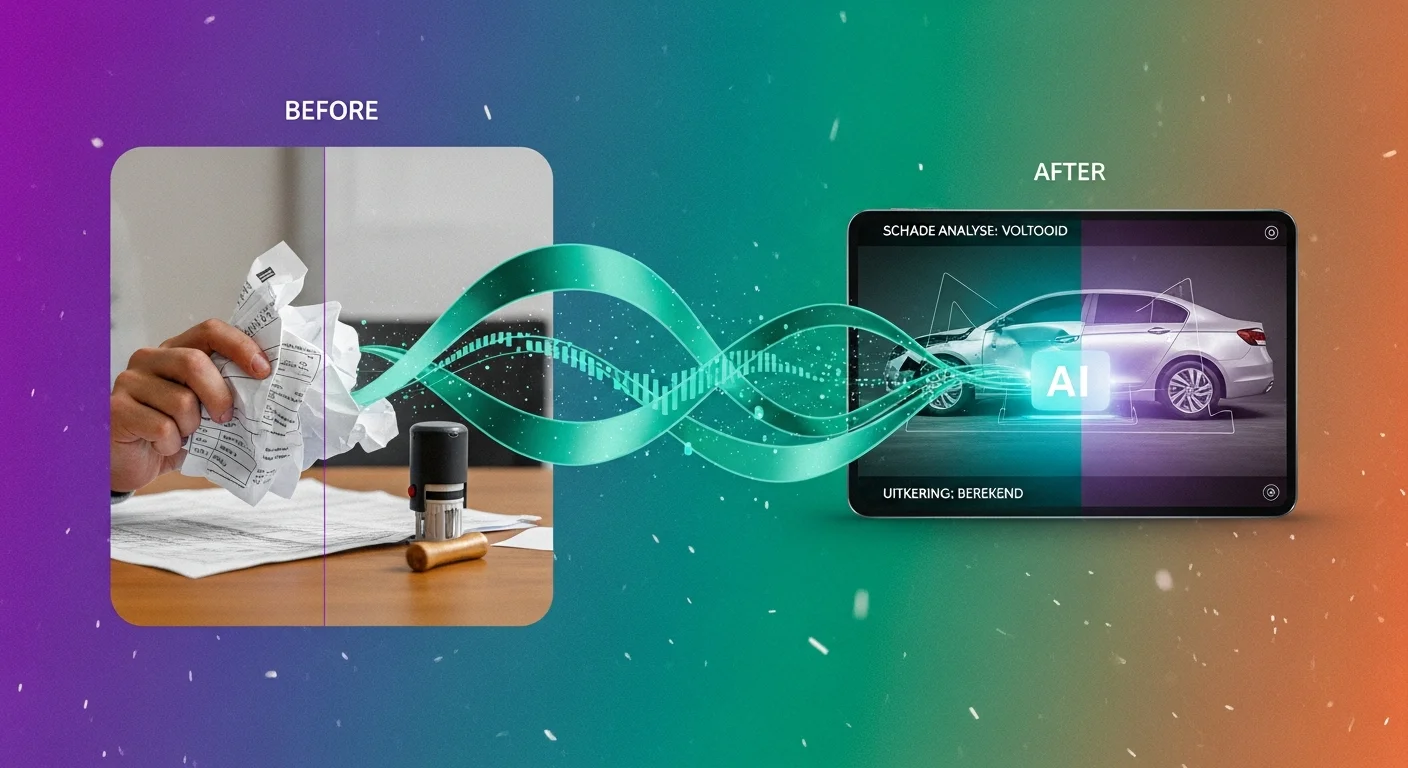
The insurance industry is being changed fundamentally by AI. From claims processing to underwriting, AI makes processes faster, more accurate and friendlier for the customer.
As an AI agency in the Netherlands we see more and more insurers taking the step. These are the applications with the biggest impact.
Why AI in insurance?
Insurers are dealing with:
- Slow claims processing: customers wait weeks for a payout
- Rising fraud costs: 10 to 15% of claims contain elements of fraud
- High operating costs: manual assessment is expensive
- Customer dissatisfaction: expectations rise, patience falls
Top AI applications for insurers
1. Automated claims processing
AI assesses claims in minutes instead of days:
- Document analysis: extracting relevant information from forms and attachments
- Photo analysis: AI assesses damage photos and estimates repair costs
- Policy matching: automatic checks on whether the claim is covered
- Payout calculation: immediate calculation of the amount due
Result: 60% of simple claims handled fully automatically. Turnaround time down from weeks to hours.
2. Fraud detection
AI spots patterns that point to fraud:
- Network analysis: identifies suspicious links between claimants
- Pattern recognition: recognises claims that deviate from normal patterns
- Document verification: detects manipulated documents and photos
- Historical analysis: compares against known fraud patterns
3. Personalisation and pricing
AI makes personalised premiums possible based on:
- The individual risk profile
- Behavioural data (with consent)
- Real-time market conditions
- Claims history and trends
4. Customer service automation
AI chatbots and agents for:
- Making policy changes
- Giving claim status updates
- Taking simple damage reports
- Giving preventive advice
Implementation roadmap
Phase 1: quick win, claims triage (month 1 to 2)
Start with AI that categorises and prioritises incoming claims. Low complexity, high impact.
Phase 2: document processing (month 2 to 4)
Automate the extraction of information from claim documents and forms.
Phase 3: fraud screening (month 4 to 6)
Implement AI models that flag suspicious claims for closer investigation.
Phase 4: full automation (month 6 to 12)
End-to-end automation of simple claims, from report to payout.
Compliance and ethics
AI in insurance calls for extra attention to:
- Transparency: customers need to know AI is part of the decision
- Preventing bias: AI models must not discriminate
- Explainability: decisions have to be explainable
- GDPR compliance: personal data processed within the law
ROI for insurers
| Metric | Without AI | With AI | Improvement |
|---|---|---|---|
| Claims turnaround | 14 days | 2 days | 86% faster |
| Fraud detection rate | 25% | 65% | 160% better |
| Operating costs | €50 per claim | €12 per claim | 76% lower |
| Customer satisfaction (NPS) | +15 | +42 | +180% |
Conclusion
AI is turning insurance from a reactive industry into a proactive one. The insurers investing now are building a lead that will be hard to bridge.
Want to know more about AI in the financial sector? Read our article on AI for financial services or get in touch for a no-obligation conversation.