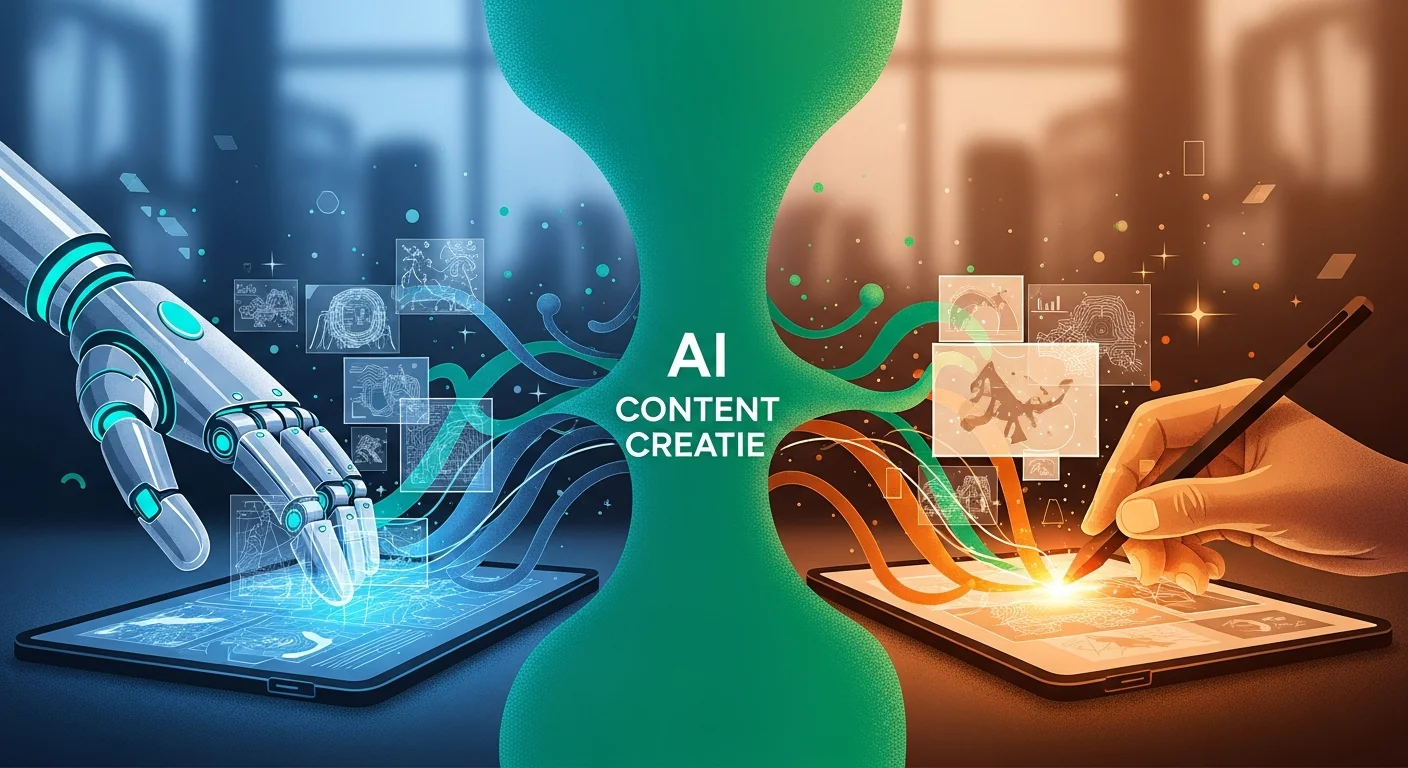
AI is fundamentally changing how we make content. Not by replacing human creativity, but by speeding up and enriching the creative process. In 2026 virtually every serious content team uses AI tools. The question is no longer whether, but how.
In this article we share our experience as an AI agency with content creation tools, strategies and best practices.
The AI content creation toolkit for 2026
Text and copywriting
| Tool | Best for | Price |
|---|---|---|
| Claude | Long articles, analysis, nuance | From €20 per month |
| ChatGPT | Broadly useful, brainstorming | From €20 per month |
| Jasper | Marketing copy, ad text | From €49 per month |
| Copy.ai | Social media, short content | From €36 per month |
Our tip: use Claude for in-depth content and ChatGPT for brainstorming and short pieces. Combine them for the best result.
Image and design
| Tool | Best for | Price |
|---|---|---|
| Midjourney | The highest image quality | From $10 per month |
| DALL-E 3 | Built into ChatGPT | Included with Plus |
| Canva AI | Marketing material | From €12 per month |
| Adobe Firefly | Professional design | Included with CC |
Video and audio
| Tool | Best for | Price |
|---|---|---|
| Runway | Video editing and generation | From $15 per month |
| Synthesia | Presentation videos with AI avatars | From €22 per month |
| ElevenLabs | Realistic speech | From $5 per month |
| Descript | Podcast editing | From $24 per month |
The 80/20 strategy for AI content
The most effective approach is the 80/20 strategy:
- 80% AI-assisted: research, structure, first drafts, variations, SEO optimisation
- 20% human: original insight, personal stories, brand personality, fact-checking
That gives you the best of both worlds: the efficiency of AI and the authenticity of human creativity.
Workflow: from idea to publication
Step 1: research and briefing (AI: 90%)
Use AI to do keyword research, analyse trending topics and put together a content brief. AI is particularly strong here, because it does in minutes what takes a person hours.
Step 2: structure and outline (AI: 80%)
Let AI propose an article structure based on the brief, the competitor analysis and your SEO requirements. Then adjust that structure with your own expertise.
Step 3: first draft (AI: 70%)
AI writes the first version. That is the base you build on, not the finished product.
Step 4: human enrichment (human: 90%)
This is where the magic happens. Add:
- Your own experience and case studies
- Sector-specific insight
- Your brand personality and tone of voice
- Original perspectives AI cannot come up with
Step 5: optimisation and publication (AI: 60%)
Use AI for SEO optimisation, meta descriptions and social media variations. Do a final human check on quality and brand standards.
Common mistakes
1. Copy-pasting AI output
The number one mistake. AI text without human editing is recognisable, not to Google but to your readers. It lacks personality, specific examples and original insight.
2. No fact-checking
AI hallucinates regularly. Always check facts, figures and claims. For legal, medical or financial content this is crucial.
3. One tool for everything
Every AI tool has strong and weak points. Use the right tool for the right job. Claude for depth, ChatGPT for brainstorming, Midjourney for images.
4. Forgetting SEO
AI content is not automatically optimised for search. Build your SEO strategy into the content creation process instead of bolting it on afterwards.
Safeguarding content quality
The EEAT checklist
Google judges content on Experience, Expertise, Authoritativeness and Trustworthiness. AI can help with the structure, but EEAT comes from people:
- Experience: share your own experience and case studies
- Expertise: show real subject knowledge
- Authoritativeness: refer to reliable sources
- Trustworthiness: be transparent and accurate
The "would I share this?" test
Before you publish, ask yourself: would I share this article with a colleague? If the answer is no, it is not good enough, no matter how much AI worked on it.
Conclusion
In 2026 AI content creation is no longer a luxury. It is a necessity for content teams that want to scale up without giving up quality. The key is to use AI as an amplifier, not as a replacement.
Start with the 80/20 strategy, pick the right tools for your needs, and always invest in the human touch that sets your content apart.
Want to put AI to work for your content marketing? Have a look at our AI automation services or book a call to talk through the possibilities.